







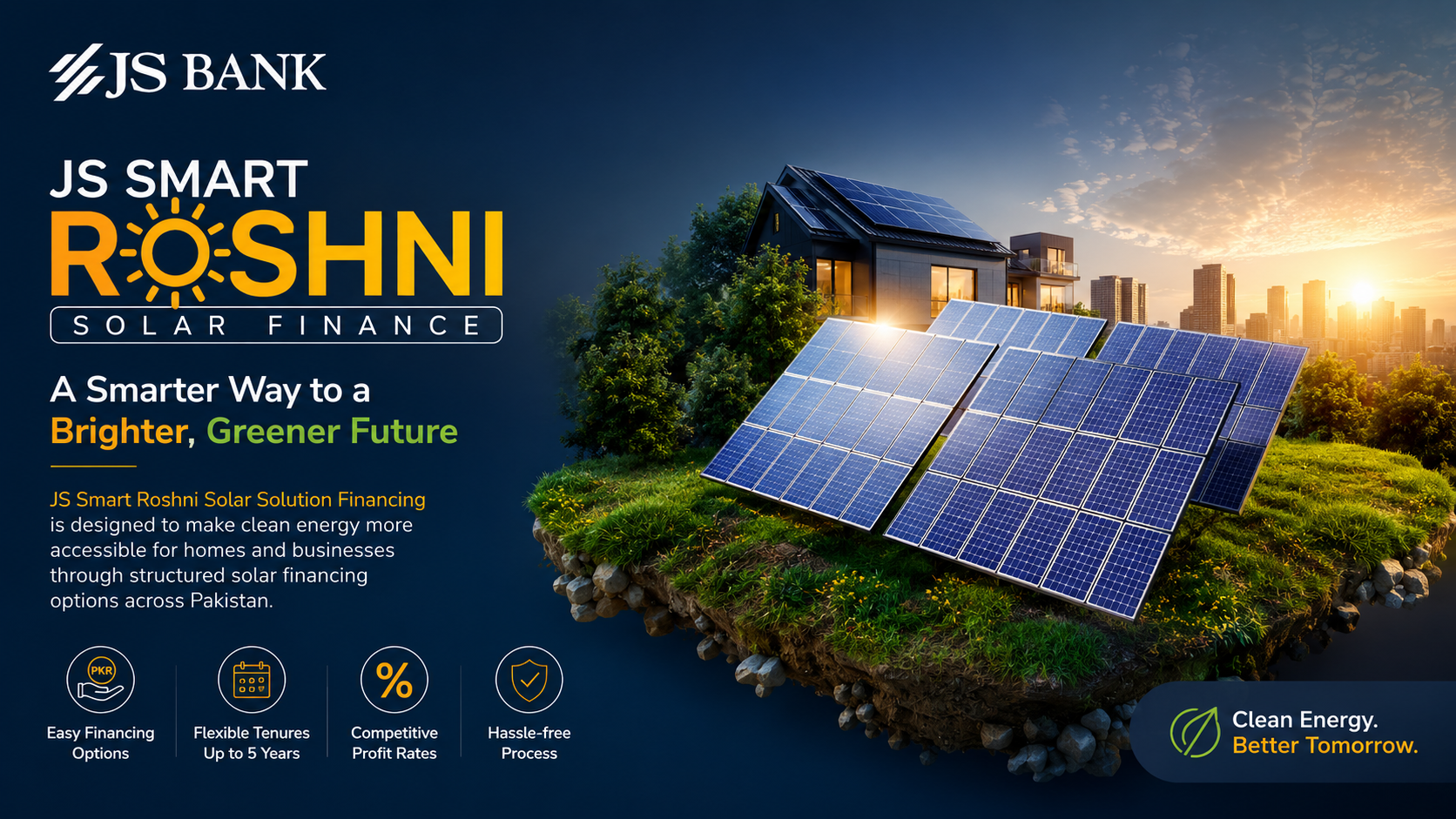
Explore JS Bank solar financing solutions that help homes and businesses adopt solar energy through structured repayment plans in Pakistan.
Key Takeaways
- Solar energy helps reduce electricity bills and supports long-term energy independence
- Pakistan’s high sunlight availability makes solar power a practical renewable solution
- Financing options make solar adoption affordable by removing large upfront costs
- Customers can repay solar systems through structured and predictable monthly installments
- JS Smart Roshni Solar Financing by JS Bank supports both residential and commercial solar adoption
- Solar financing enables faster transition to clean energy with better financial flexibility
Rising electricity bills and increasing awareness of sustainability are encouraging more households and businesses to explore renewable energy options. For many consumers, JS Bank solar financing program called JS Smart Roshni provides a practical way to transition toward cleaner energy through structured repayment plans. By making solar adoption more accessible, financing solutions help customers reduce dependence on conventional electricity while supporting long-term energy efficiency.
As Pakistan continues to face growing energy demands, solar power is increasingly becoming a reliable and sustainable solution for both residential and commercial users.
Why Solar Energy Is Becoming More Popular
Pakistan receives abundant sunlight throughout the year, averaging around 5.5 to 7 peak sun hours daily, making solar energy one of the country’s most practical renewable energy resources. The country also receives roughly 300+ sunny days per year, which significantly strengthens solar generation potential.
As consumers seek greater control over energy expenses and reliability, solar adoption has surged, with Pakistan’s installed solar capacity crossing several gigawatts in recent years and continuing to grow rapidly as net-metering expands across urban and semi-urban areas.
A modern solar system converts sunlight into electricity through photovoltaic panels, helping households and businesses generate their own power while reducing reliance on traditional energy sources. In many cases, users report electricity bill reductions of 40% to 80%, depending on system size and usage patterns, making solar an increasingly cost-effective long-term solution.
Key benefits include:
- Lower electricity expenses
- Reduced dependence on the grid
- Cleaner energy generation
- Greater energy independence
- Long-term sustainability benefits
These advantages have contributed to the growing adoption of solar power for homes and commercial properties across Pakistan.
The Rise of Renewable Energy in Pakistan
Pakistan’s renewable energy sector has expanded significantly in recent years, with solar energy emerging as one of the fastest-growing segments. Favorable weather conditions, improved technology, and increasing awareness have encouraged more consumers to explore cleaner energy sources.
Many regions of Pakistan receive average solar irradiance levels between 5.3 and 6.5 kWh/m² per day, making solar installations highly effective for electricity generation. This natural advantage has positioned solar energy as one of the most accessible alternative energy solutions available to households and businesses.
As adoption continues to increase, solar energy is becoming both an environmental and financial consideration for consumers seeking long-term value.
Overcoming the Initial Investment Barrier
While solar energy offers long-term benefits, many households and businesses may hesitate to make the transition due to the initial investment involved. Financing solutions help overcome this barrier by enabling customers to adopt solar technology through structured repayment plans rather than making a large one-time payment.
This approach makes renewable energy more accessible while allowing customers to maintain financial flexibility. Instead of delaying installation, households and businesses can begin benefiting from solar energy while managing repayments through predictable monthly installments.
Financing facilities typically support the complete solar solution, including:
- Solar panels
- Inverters
- Mounting structures
- Installation services
- Associated electrical equipment
By spreading costs over time, financing options help more customers access clean energy solutions while supporting long-term energy savings and sustainability goals.
How Solar Financing Supports Customers
A structured Solar Loan in Pakistan allows eligible customers to install solar systems while managing repayments through organized monthly installments.
Rather than postponing the transition to renewable energy, customers can start benefiting from solar technology while spreading payments over an agreed financing period.
Potential advantages include:
- Reduced upfront financial burden
- Predictable monthly repayments
- Easier budget planning
- Access to quality solar solutions
- Long-term energy savings
This approach supports both affordability and responsible financial planning.
The Role of Banks in Supporting Clean Energy
Financial institutions play an important role in accelerating renewable energy adoption by providing financing solutions that improve accessibility.
Through programs focused on solar financing in Pakistan, banks help households and businesses transition to solar energy while managing costs through structured repayment facilities. These initiatives contribute to broader sustainability goals while helping consumers invest in energy-efficient technologies.
As renewable energy adoption continues to grow, financing solutions remain an important enabler of long-term energy transformation.
Understanding JS Smart Roshni Solar Financing
As demand for solar energy increases, financial institutions have introduced dedicated solutions to support customers looking to install solar systems.
JS Smart Roshni is designed to support both residential and commercial solar requirements through structured financing facilities.
Key features include:
- Financing available between PKR 500,000 and PKR 10,000,000
- Equal Monthly Installment (EMI) repayment structure
- Minimum 20% equity contribution of the total solution value
- Processing fees and charges as per the Bank’s updated Schedule of Charges
- Small and Medium Enterprise financing based on business cash flows
Collateral requirements include:
- Hypothecation of the energy solution through authorized vendors
- Personal guarantee
- Post-dated cheques
- Additional collateral where applicable
These features provide a structured framework that supports customers in adopting solar technology through regulated financing arrangements.
Eligibility Requirements
Applicants are generally required to meet the following criteria:
- Pakistani nationality
- Business operating for at least one year (where applicable)
- Proof of ownership of the installation premises or NOC from the owner
- Satisfactory credit history
- Financial ability to repay financing obligations
These requirements help ensure responsible lending while supporting sustainable energy adoption.
Choosing the Right Solar Solution
Before installing a solar system, customers should evaluate their energy needs and property requirements.
Factors to consider include:
- Average electricity consumption
- Available installation space
- Sunlight exposure
- Equipment quality and warranties
- Installation expertise and after-sales support
A properly designed solar system can help maximize energy generation and improve long-term efficiency.
Final Thoughts
The transition toward solar energy is accelerating as consumers seek reliable, sustainable, and cost-efficient energy solutions. Financing programs play an important role in supporting this shift by making renewable energy more accessible through structured repayment options.
Solutions such as JS Bank solar financing is helping households and businesses move toward greater energy independence and long-term savings.
FAQs
1. What is JS Smart Roshni Solar Financing?
It is a financing facility that enables eligible customers to install solar systems through structured monthly repayments.
2. Who can apply for solar financing?
Eligible Pakistani nationals and qualifying businesses that meet the financing criteria can apply.
3. Can businesses also benefit from solar financing?
Yes. The facility supports both residential and commercial solar energy requirements.
4. Why is solar energy becoming more popular in Pakistan?
Abundant sunlight, rising energy costs, and growing awareness of sustainability are encouraging more consumers to adopt solar solutions.
5. What types of solar systems can be financed under JS Smart Roshni Solar Financing?
The financing facility typically supports a range of residential and commercial solar solutions, including on-grid and hybrid systems, depending on customer eligibility and energy requirements.
6. How does solar financing help reduce electricity costs over time?
Solar financing allows users to install solar systems without a large upfront cost, enabling them to generate their own electricity and gradually reduce monthly utility bills through long-term savings.
7. What happens after the solar system is installed and financed?
After installation, customers begin repaying the financed amount through agreed monthly installments while benefiting from reduced electricity expenses generated by the solar system.
8. What makes JS Smart Roshni Solar Financing a good option for customers?
JS Smart Roshni Solar Financing offered by JS Bank makes solar adoption more affordable by providing flexible repayment plans, enabling customers to install solar systems without heavy upfront costs while gradually patient through manageable monthly installments.